
 Emerging evidence
Astragalus
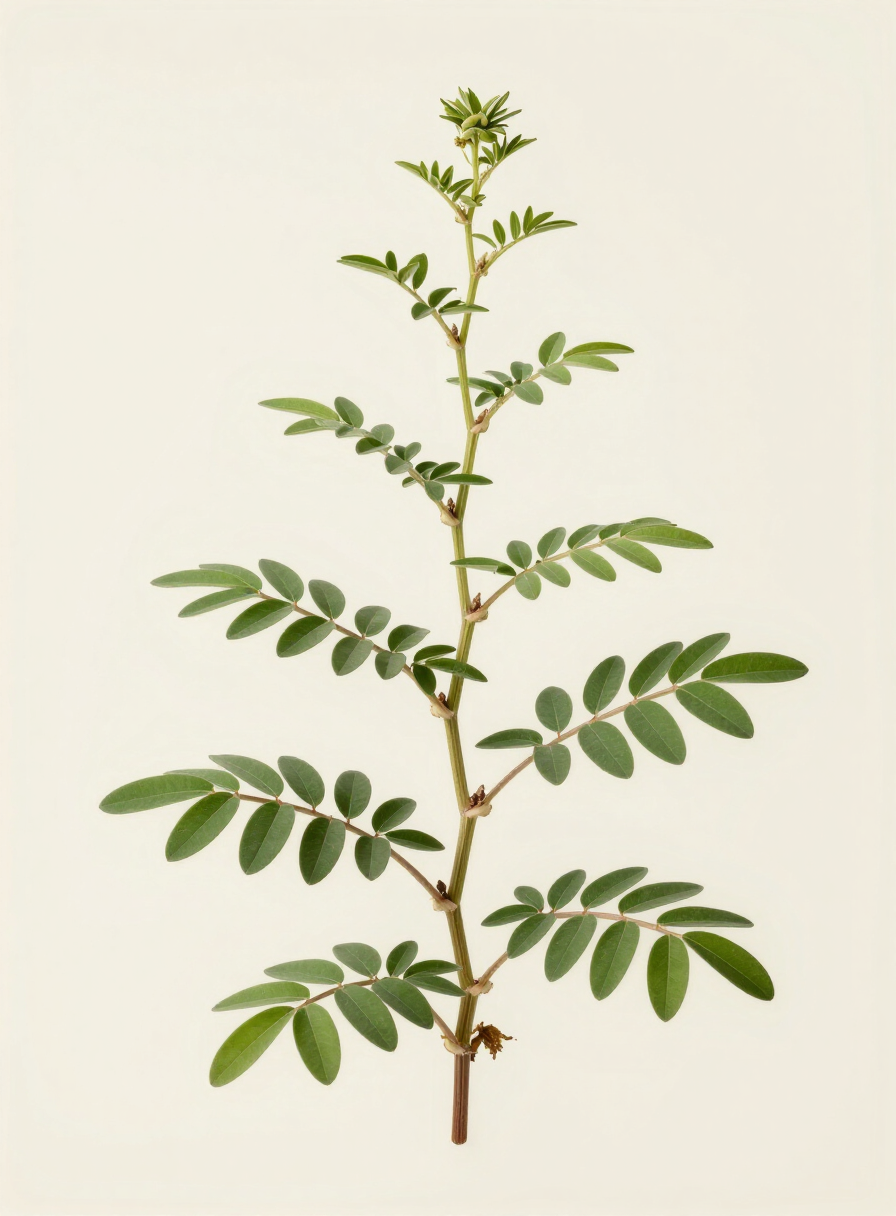
Astragalus mongholicus Bunge
Overview
At a glance
Astragalus is a large genus of Fabaceae plants. This HerbParlor profile specifically represents the medicinal Astragali Radix (Huang Qi) identity associated with Astragalus mongholicus Bunge and the scientific synonym Astragalus membranaceus used extensively in the literature. Human research is limited, heterogeneous and preparation-dependent.
Key takeaway
Astragalus has extensive traditional and scientific literature, but reliable clinical evidence for health outcomes remains limited and heterogeneous. Findings from adjunctive use, multi-herb formulas or specific extracts should not automatically be generalized to every commercial Astragalus product or to Astragalus alone.
Common uses studied
Traditional Chinese-medicine context for Huang Qi / Astragali RadixType 2 diabetes adjunctive-intervention researchHuman immune-response biomarker researchIdiopathic membranous nephropathy adjunctive-intervention researchCommercial Astragalus root, extract and combination products
Start here
What are you trying to figure out?
Pick the question closest to yours. Each card jumps to the relevant part of this profile or an existing HerbParlor tool — no sponsored rankings, no hidden ordering.
Identity
What is this herb?
Family
Fabaceae
Species
Astragalus mongholicus Bunge
Common names
AstragalusHuang QiAstragali RadixMilk vetch
Plant parts used
Root (dried)
Geographic context
Astragalus is a large genus distributed across temperate regions. The medicinal Astragali Radix material is principally associated with Astragalus mongholicus Bunge and its synonym Astragalus membranaceus Fisch. ex Bunge as used in the literature.
Identification notes
Kew currently accepts Astragalus mongholicus Bunge as the canonical species; Astragalus membranaceus Fisch. ex Bunge is recorded as a scientific synonym. This profile refers to that accepted species and its synonym only. The genus Astragalus contains many species, and a product labelled only "Astragalus" should not automatically be treated as botanically equivalent to the canonical medicinal material. Huang Qi and Astragali Radix are traditional and pharmacopoeial terms for the dried root, not separate species.
Background
Traditional context
Traditions
Traditional Chinese medicine context for Huang Qi / Astragali Radix
Historical uses
Traditional use of Astragali Radix (Huang Qi) dried-root preparationsHistorical use within traditional Chinese-medicine frameworks
Traditional Chinese-medicine concepts such as "qi tonification" provide cultural and historical context and should not be translated into biomedical efficacy claims. Clinical conclusions should be based on the specific human evidence and preparation studied, not on traditional categories.
Preparations
Forms & preparations
Forms
Dried rootRoot powderDecoction / teaRoot extractStandardized extract where explicitly characterizedCapsuleTabletLiquid preparationMulti-herb formula
Preparation methods
Dried root materialPowdered rootHot-water decoction or infusionDry or liquid extract preparationStandardized extract preparation where explicitly disclosed
What changes between forms
- Dried root, root powder, decoction, extract and standardized extract are not automatically equivalent preparations.
- A standardized or characterized extract studied in research is not automatically equivalent to ordinary root powder, a decoction or every commercial product.
- Species, plant part, extraction method and combination formula can materially change what evidence applies.
- A multi-herb formula should not automatically be treated as evidence for Astragalus alone.
- Capsules, tablets, liquids and teas may contain different amounts and preparations of root material.
Human studies have used different Astragalus preparations, including root, extracts, standardized extracts and multi-herb or adjunctive interventions. Findings from a specific preparation or formula should not automatically be generalized to every Astragalus product.
Research
Research Explorer
Each question summarizes what human research has examined, how it was studied, and the main limitations — not a treatment recommendation.
What does human research show about Astragalus and type 2 diabetes outcomes?
Population
Adults with type 2 diabetes represented in clinical trials and a systematic review/meta-analysis of Astragalus as an adjunctive intervention.
Intervention
Astragalus preparations used as an adjunct to conventional diabetes care, including root, extracts or formulas where specified.
Comparator
Conventional care, placebo or comparator interventions where used.
Outcomes studied
Glycemic measuresRelated metabolic measuresAdverse events
Evidence assessment
A 2023 systematic review and meta-analysis reported improvements in some glycemic measures when Astragalus was used as an adjunctive intervention in type 2 diabetes. The interpretation is limited by evidence-certainty and risk-of-bias concerns. These findings do not establish Astragalus as an established diabetes treatment and should not be generalized to every commercial Astragalus product.
Limitations
- Evidence-certainty and risk-of-bias limitations
- Adjunctive use rather than Astragalus alone
- Variation in preparations, doses, durations and outcome measures
- Findings should not be generalized to every commercial product
What does human research show about immune-response measures?
Population
Individuals studied for human immune-response outcomes in clinical trials and a systematic review/meta-analysis of Astragalus preparations.
Intervention
Astragalus preparations as described in the included studies.
Comparator
Placebo, no treatment or comparator interventions where used.
Outcomes studied
Immune biomarkersInfection or clinical outcomes where reported
Evidence assessment
A 2023 systematic review and meta-analysis examined human immune-response studies. Changes in immune biomarkers should be distinguished from clinical protection against infection or disease. Interpretation is limited by small sample sizes and heterogeneity. The evidence does not establish universal "immune boosting" or proven prevention of infections.
Limitations
- Small sample sizes
- Heterogeneity across studies
- Biomarker changes are not the same as patient-important clinical outcomes
- Findings should not be generalized to every commercial product
What evidence exists for Astragalus-containing interventions in membranous nephropathy?
Population
People with moderate- or high-risk idiopathic membranous nephropathy represented in clinical research on Astragalus-containing interventions.
Intervention
Astragalus-containing adjunctive interventions, often as part of multi-herb formulas or combined with conventional treatment.
Comparator
Conventional treatment or comparator interventions where used.
Outcomes studied
Kidney-disease-related measuresRemission or proteinuria outcomes where reportedAdverse events
Evidence assessment
A 2023 systematic review and meta-analysis examined Astragalus-containing interventions in moderate- or high-risk idiopathic membranous nephropathy. These were adjunctive and often formula-based interventions, and the evidence carries study limitations. Idiopathic membranous nephropathy should be distinguished from diabetic kidney disease. The findings should not be generalized to every commercial Astragalus supplement or to Astragalus alone.
Limitations
- Adjunctive and often formula-based interventions
- Study limitations preserved from the review
- Idiopathic membranous nephropathy is distinct from diabetic kidney disease
- Findings should not be generalized to every commercial product
How much evidence concerns Astragalus alone versus multi-herb formulas or adjunctive treatment?
Population
People comparing Astragalus-alone interventions with multi-herb formulas or adjunctive treatment in the available human literature.
Intervention
Astragalus alone, Astragalus-containing multi-herb formulas, or Astragalus as an adjunct to conventional treatment.
Comparator
Varies by study and review.
Outcomes studied
Outcome-specific measuresEvidence interpretability
Evidence assessment
Much of the human evidence concerns Astragalus-containing multi-herb formulas or adjunctive use alongside conventional treatment rather than Astragalus alone. A multi-herb formula or adjunctive result should not automatically be treated as evidence for Astragalus alone, and findings should not be generalized to every commercial product.
Limitations
- Mixed single-herb, formula and adjunctive interventions
- Difficulty isolating the contribution of Astragalus
- Variation in preparations and outcome measures
Sources
- Astragalus as an adjunctive intervention in type 2 diabetes — systematic review and meta-analysis
- Astragalus and human immune-response studies — systematic review and meta-analysis
- Astragalus-containing interventions in idiopathic membranous nephropathy — systematic review and meta-analysis
- Astragalus — health information
How much does botanical identity and preparation affect interpretation?
Population
People comparing commercial Astragalus products with the species and preparations studied in human research.
Intervention
Different Astragalus species, plant parts, preparations and extracts.
Comparator
Not applicable.
Outcomes studied
Species identityPreparation identityEvidence interpretability
Evidence assessment
The genus Astragalus contains many species. Astragalus mongholicus Bunge (with Astragalus membranaceus as a synonym) is the canonical medicinal identity for Astragali Radix, but a product labelled only "Astragalus" should not automatically be treated as botanically equivalent. Root, root powder, decoction, extract and standardized extract are not automatically interchangeable preparations.
Limitations
- Commercial labels may omit species and preparation details
- Studies do not use one uniform Astragalus intervention
- Standardization is not consistently disclosed or comparable
What quality, adulteration and traceability issues matter when evaluating Astragalus products?
Population
People evaluating commercial Astragalus products for quality, identity and traceability.
Intervention
Commercial Astragalus root, powder and extract products.
Comparator
Not applicable.
Outcomes studied
Species identityAdulteration and contaminationTraceabilityChemical variability
Evidence assessment
Quality-control evidence indicates that Astragalus products can be affected by species identity issues, adulteration and contamination, geographic and cultivation differences, traceability gaps and chemical variability. The presence of chemical markers should be treated as a product-quality disclosure, not as proof of clinical effectiveness.
Limitations
- Quality does not equal clinical efficacy
- Supply-chain and cultivation variation
- Chemical-marker presence is not proof of effectiveness
Latest evidence
Recently published research
Looking for recent publications…
These publications are automatically discovered from Europe PMC. They have not necessarily been independently reviewed by HerbParlor and are not automatically incorporated into the evidence assessment.
Evidence
Evidence
Human research on Astragalus is limited, heterogeneous and preparation-dependent. A 2023 meta-analysis reported improvements in some glycemic measures when Astragalus was used as an adjunct in type 2 diabetes, with evidence-certainty and risk-of-bias limitations; immune-response evidence concerns biomarker changes rather than proven clinical protection; and membranous-nephropathy evidence concerns adjunctive, often formula-based interventions in idiopathic disease. NCCIH concludes there is insufficient reliable evidence to establish that Astragalus is useful for any specific health condition. Current evidence does not establish Astragalus as a proven treatment for diabetes, kidney disease, or as a universal immune booster.
Evidence tier
Emerging
Confidence
Overall confidence is limited and low-certainty where appropriate. The main uncertainties concern species identity, preparation, dose, duration, study quality, sample size, risk of bias and whether findings concern Astragalus alone or adjunctive/formula-based interventions. Evidence from a specific preparation or formula should not automatically be generalized to every commercial Astragalus product.
Last evidence review
2026-09-20
Where the evidence is strongest
Outcome-specific synthesis separating type 2 diabetes, immune-response and membranous-nephropathy evidenceSpecies-aware and preparation-aware interpretation distinguishing Astragali Radix from the broader Astragalus genus
How to interpret this
Astragalus evidence should be interpreted at the level of the identified species, plant part, preparation, amount, outcome and whether the intervention was Astragalus alone or an adjunctive/formula-based treatment. The current human literature is limited, heterogeneous and preparation-dependent; it does not justify broad therapeutic claims, universal "immune boosting" claims, or automatic equivalence between species, preparations or formulas. NCCIH concludes there is insufficient reliable evidence to establish usefulness for any specific health condition.
Automatic evidence update
Since the last editorial review
Checking for publications published since the last editorial evidence review…
This automatic update detects newly published literature; it does not replace HerbParlor's editorial evidence assessment. Review status is an automatic triage signal. Curated HerbParlor evidence is unchanged until editorial review.
Boundaries
What the evidence does NOT establish
Areas with limited evidence
- Broad claims that Astragalus treats diabetes, kidney disease or boosts immunity
- Generalization across species, root powder, extracts and multi-herb formulas
- Translation of biomarker changes into patient-important clinical outcomes
- Translation of traditional "qi tonification" concepts into biomedical efficacy
Evidence gaps
- Larger, longer and well-described randomized trials with low risk of bias
- Direct comparisons of Astragalus alone versus multi-herb formulas or adjunctive use
- Consistent reporting of species, plant part, preparation, amount and extract characteristics
- Independent confirmation of clinically meaningful outcomes
Common misconceptions
- Astragalus is a genus, not one universal species.
- "Astragalus" on a label does not automatically establish species identity.
- Astragali Radix root is not equivalent to every Astragalus species.
- Biomarker changes are not the same as patient-important clinical outcomes.
- A multi-herb formula does not automatically validate Astragalus alone.
- One extract does not automatically validate every Astragalus preparation.
- Traditional-use concepts are not clinical proof.
- More Astragalus does not automatically mean better evidence.
Safety
Safety & interactions
General considerations
- According to NCCIH, overall safety of Astragalus has not been comprehensively established. Safety should be interpreted according to the specific preparation, amount and duration studied.
- Possible concerns have been raised for people with autoimmune disease, and possible interaction with immunosuppressive medicines has been described. The available sources do not justify an exhaustive interaction list here.
- Oral root preparations should be distinguished from topical products; the two are not automatically interchangeable.
- Traditional or food-level exposure should be distinguished from concentrated extracts; food-level use should not be assumed to be equivalent to concentrated supplements.
Pregnancy & nursing
- Pregnancy and breastfeeding safety information is limited; safety should not be assumed for every Astragalus preparation, particularly concentrated extracts.
- People who are pregnant or breastfeeding should discuss a specific product with a qualified healthcare professional.
Medication interactions to be aware of
Possible interaction with immunosuppressive medicines has been described. People taking medicines, particularly immunosuppressants, should discuss a specific product with a qualified healthcare professional rather than infer safety from traditional use.
Condition considerations
- People with autoimmune disease or those taking immunosuppressive medicines should seek professional advice about a specific product.
- Uncertainty is greater when a product does not identify its species, plant part, preparation or amount.
Duration
- Long-term safety of concentrated Astragalus extracts is not comprehensively established for every commercial product.
Talk to a healthcare professional if any apply
- Pregnancy or breastfeeding
- Autoimmune disease
- Use of immunosuppressive or other prescription medicines
- Persistent or unexplained symptoms
- Use of a concentrated extract with unclear composition
- Significant or unexpected adverse effects
Products
What changes between products?
Form differences
- Dried root, root powder, decoction, extract and standardized extract are not automatically equivalent preparations.
- A standardized or characterized extract studied in research is not automatically equivalent to ordinary root powder, a decoction or every commercial product.
- Species, plant part, extraction method and combination formula can materially change what evidence applies.
- A multi-herb formula should not automatically be treated as evidence for Astragalus alone.
- Capsules, tablets, liquids and teas may contain different amounts and preparations of root material.
Form considerations
- Dried root, root powder, decoction, extract and standardized extract can represent different amounts and preparations.
- Do not compare products solely by package size or headline Astragalus weight.
Plant part considerations
- Confirm that the product uses identified Astragali Radix root material when that is the intended preparation.
- Do not treat other plant parts or other Astragalus species as automatically equivalent.
Extract considerations
- Record extraction information only when the product source explicitly provides it.
- Do not infer an extraction ratio, concentration or clinical equivalence from a label that does not provide it.
Standardization considerations
- Record declared standardization only when genuinely disclosed.
- Do not invent astragaloside concentrations, extract ratios or a preferred standardization level.
- Do not imply that a standardized product is automatically more effective.
Evaluation
How to evaluate a supplement
What to check
- Astragalus species identity where disclosed
- Botanical name where provided
- Plant part, especially root versus other material
- Whole root versus extract
- Preparation: dried root, powder, decoction, extract, capsule, tablet or liquid
- Serving information only when genuinely disclosed
- Extraction information where explicitly disclosed
- Standardization where genuinely disclosed
- Marker compounds only when actually specified
- Whether the product is Astragalus alone or a combination formula
- Other ingredients and label transparency
- Quality, testing, adulteration and provenance where disclosed
Serving considerations
- Compare the labelled amount and preparation with the intervention used in the relevant research without inventing a dosage recommendation.
- A larger declared amount does not automatically mean a stronger or better-supported product.
Testing considerations
- Look for species and plant-part identity testing where disclosed.
- Look for contaminant, adulterant and batch or lot traceability where disclosed.
- Treat testing and chemical-marker information as product-quality disclosure, not proof of clinical efficacy.
Label transparency
- The species and botanical name should be clear where possible.
- Root, powder, extract and other preparation details should be explicit.
- Serving information should be explicit when disclosed.
- Combination ingredients should be listed.
- Extract or standardization claims should be specific and sourceable.
- Marketing language should not be treated as human clinical evidence.
Supplements
Related supplements
- Natur Drogeriet Astragalus (90 kaps)Natur DrogerietView product
- Best Naturals Astragalus 1000 mg, 120 CapsBest NaturalsView product
- Nature's Answer Astragalus Root Alcohol Free, 1 OzNature's AnswerView product
- Eclectic Herb Astragalus Extract, 2 OzEclectic HerbView product
- Herb Pharm Astragalus, 4 fl oz (118.4 ml)Herb PharmView product
- Nature's Answer Astragalus Root Capsules 500 mg, 60 CountNature's AnswerView product
- Planetary Herbals Full Spectrum Astragalus Extract, 60 TabsPlanetary HerbalsView product
- NOW Foods Astragalus 500 mg, 100 Veg CapsNOW FoodsView product
- NOW Foods Astragalus Extract 500 mg, 90 Veg CapsNOW FoodsView product
- Celebration Herbals Organic Astragalus Root Tea, 24 BagsCelebration HerbalsView product
Sources
Authoritative sources referenced
- Astragalus mongholicus Bunge — Plants of the World Online
Royal Botanic Gardens, Kew · accessed 2026-09-20
- Astragalus — health information
National Center for Complementary and Integrative Health · accessed 2026-09-20
- Astragalus as an adjunctive intervention in type 2 diabetes — systematic review and meta-analysis
PubMed · 2023 · accessed 2026-09-20
- Astragalus and human immune-response studies — systematic review and meta-analysis
PubMed · 2023 · accessed 2026-09-20
- Astragalus-containing interventions in idiopathic membranous nephropathy — systematic review and meta-analysis
PubMed · 2023 · accessed 2026-09-20
- Astragali Radix — botany, phytochemistry, pharmacology and clinical-application review
PubMed · 2024 · accessed 2026-09-20
- Astragali Radix quality control, adulteration, contamination, cultivation and supply-chain variation
PubMed · 2020 · accessed 2026-09-20
Sections reviewed
overviewbotanicaltraditionalContextpreparationsresearchevidencesafetyproductEvaluationrelationshipssources
Created the Astragalus Herb Profile v1 with canonical Astragalus mongholicus Bunge identity, Astragalus membranaceus recorded as a scientific synonym, Astragali Radix (Huang Qi) dried root as the canonical medicinal material, preparation- and species-aware human evidence across type 2 diabetes, immune response and membranous nephropathy, NCCIH-based cautious safety framing, quality/adulteration context, product-evaluation criteria and auditable review metadata.
This profile is provided for educational purposes only and is not medical advice. Traditional context and research summaries are distinguished from claims, and nothing here is a treatment recommendation. Always consult a qualified healthcare professional before using any herb, especially if you are pregnant, nursing, take medication, or have a medical condition.