
 Emerging evidence
Ginseng
Panax ginseng C.A.Mey.
Overview
At a glance
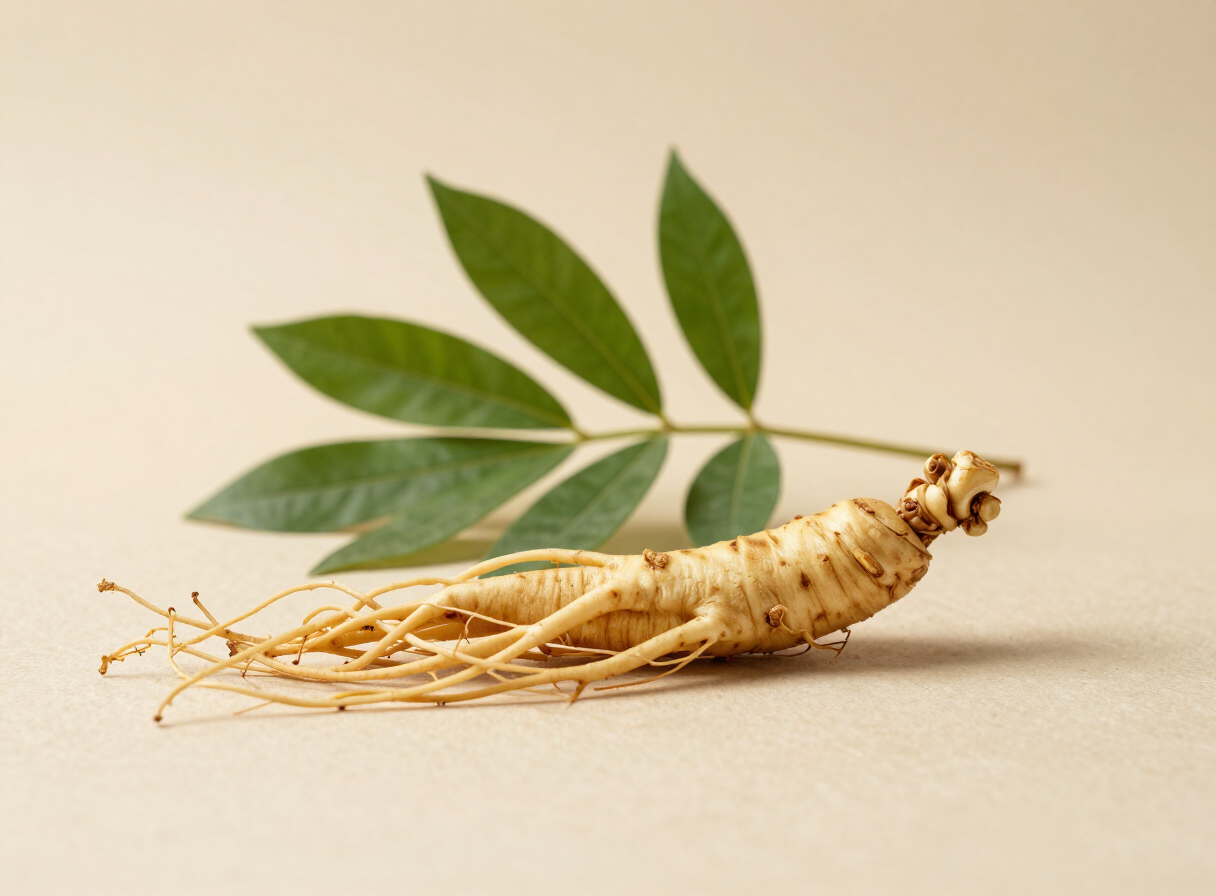
Asian ginseng is the root of Panax ginseng. Human research has examined ginseng across fatigue, cognition, cardiometabolic outcomes, sexual function and other uses, but findings vary by indication, preparation and study quality.
Key takeaway
Ginseng is not a single uniform intervention: species identity, root preparation, processing, extraction and whether the product is used alone or in a combination all matter when interpreting research.
Common uses studied
Fatigue researchCognitive-function researchCardiometabolic researchTraditional herbal useCommercial ginseng preparations
Start here
What are you trying to figure out?
Pick the question closest to yours. Each card jumps to the relevant part of this profile or an existing HerbParlor tool — no sponsored rankings, no hidden ordering.
Identity
What is this herb?
Family
Araliaceae
Species
Panax ginseng C.A.Mey.
Common names
GinsengAsian ginsengKorean ginsengRed ginsengWhite ginseng
Plant parts used
Root
Geographic context
Native range extends from the Russian Far East to Korea.
Identification notes
Panax ginseng is the canonical species for this HerbParlor Ginseng profile. American ginseng and Eleuthero are different plants and should not be treated as synonyms or interchangeable canonical herbs.
Background
Traditional context
Traditions
East Asian herbal-medicine context
Historical uses
Traditional use of Panax ginseng root preparationsHistorical use in traditional East Asian medicine
Traditional use and regulatory recognition provide historical or regulatory context and should not be treated as proof of clinical efficacy.
Preparations
Forms & preparations
Forms
Dried rootPowdered rootRed ginsengWhite ginsengLiquid extractSoft extractDry extractCapsuleTabletTea
Preparation methods
Dried rootSteamed then dried rootPowdered/comminuted rootEthanolic extractOther disclosed extraction methods
What changes between forms
- Asian ginseng products can use different forms and preparations of the root.
- White ginseng and red ginseng differ in processing.
- Extraction can change the resulting preparation and composition.
- Evidence for one preparation should not automatically be generalized to every ginseng product.
- Combination formulas should not automatically be treated as equivalent to ginseng used alone.
Regulatory and clinical sources distinguish ginseng preparations by plant material and processing. Preparation identity therefore matters when interpreting evidence.
Research
Research Explorer
Each question summarizes what human research has examined, how it was studied, and the main limitations — not a treatment recommendation.
Does Asian ginseng improve fatigue?
Population
Adults experiencing fatigue, including general fatigue and fatigue associated with chronic conditions where studied.
Intervention
Panax ginseng / Asian ginseng preparations.
Comparator
Placebo or control interventions.
Outcomes studied
Fatigue severityGeneral fatigueQuality of lifeAdverse events
Evidence assessment
Fatigue findings are mixed. A 2023 systematic review and meta-analysis found no statistically significant reduction in overall fatigue severity across pooled studies, while subgroup analyses reported effects for general fatigue and some ginseng formulas.
Limitations
- Different ginseng preparations and formulas were studied.
- Studies varied in fatigue definitions and outcome measures.
- Effect sizes were small.
- Findings should not be generalized to every commercial product.
What does research show about Asian ginseng and cognitive function?
Population
Adults studied for cognitive outcomes.
Intervention
Asian ginseng preparations.
Comparator
Placebo or control interventions.
Outcomes studied
AttentionAbstract thinkingArithmetic skillsReaction timeMemory
Evidence assessment
Some small studies suggest possible effects on selected cognitive measures in some adults, but findings are limited and not established as a general cognitive benefit.
Limitations
- Many trials are small and short.
- Findings differ by age and outcome.
- Memory findings may depend on combination with other ingredients such as ginkgo.
What does research show about Asian ginseng and blood sugar or cardiometabolic outcomes?
Population
People with prediabetes or diabetes in clinical studies.
Intervention
Asian ginseng preparations.
Comparator
Placebo or control interventions.
Outcomes studied
Fasting blood glucoseCholesterolInflammatory markersOther cardiometabolic measures
Evidence assessment
Research has reported changes in some cardiometabolic measures, but evidence for improving blood sugar control in diabetes remains inconclusive and conflicting.
Limitations
- Different populations and preparations were studied.
- Clinical outcomes are not uniform.
- Results for biomarkers should not automatically be interpreted as disease-treatment effects.
What does research show about Asian ginseng and sexual function?
Population
Adults studied for erectile or sexual-function outcomes.
Intervention
Asian ginseng preparations.
Comparator
Placebo or control interventions.
Outcomes studied
Sexual-function measuresErectile-function measures
Evidence assessment
Some clinical research has reported improvements in selected sexual-function outcomes, but the evidence is indication-specific and should not be generalized to all ginseng products.
Limitations
- Study populations and preparations differ.
- Some evidence is small or limited.
- Combination products should not be treated as equivalent to ginseng alone.
Why does the type of ginseng preparation matter?
Population
Commercial ginseng users and participants in clinical research.
Intervention
Different Panax ginseng root preparations and extracts.
Comparator
Not applicable.
Outcomes studied
Preparation characteristicsInterpretability of clinical evidence
Evidence assessment
Processing and extraction differences are important when interpreting research and comparing commercial products.
Limitations
- Clinical evidence is not directly interchangeable across preparations.
- Commercial labels may not describe preparations in the same way as research studies.
Latest evidence
Recently published research
Looking for recent publications…
These publications are automatically discovered from Europe PMC. They have not necessarily been independently reviewed by HerbParlor and are not automatically incorporated into the evidence assessment.
Evidence
Evidence
Human research on Panax ginseng covers several indications, but the certainty and consistency of evidence vary substantially by outcome and preparation. Fatigue, cognition, cardiometabolic outcomes and sexual function have all been studied, while many other proposed uses remain insufficiently established.
Evidence tier
Emerging
Confidence
Moderate confidence that the evidence is indication- and preparation-specific rather than supporting a single universal clinical effect. Lower confidence for broad claims across different commercial formulations.
Last evidence review
2026-09-18
Where the evidence is strongest
Human evidence synthesis for fatiguePreparation-aware interpretation of Asian ginseng research
How to interpret this
Ginseng evidence should be interpreted at the level of the species, root preparation, processing method, extract and indication studied. Evidence for one preparation or indication should not automatically be generalized to every ginseng product.
Automatic evidence update
Since the last editorial review
Checking for publications published since the last editorial evidence review…
This automatic update detects newly published literature; it does not replace HerbParlor's editorial evidence assessment. Review status is an automatic triage signal. Curated HerbParlor evidence is unchanged until editorial review.
Boundaries
What the evidence does NOT establish
Areas with limited evidence
- Generalization across preparations
- Other proposed uses
- Longer-term outcomes
- Commercial formulation equivalence
Evidence gaps
- Direct comparisons between distinct commercial Panax ginseng preparations
- Long-term evidence for specific commercial formulations
- How processing and extraction differences affect individual clinical outcomes
Common misconceptions
- Asian ginseng is established as a universally effective treatment for fatigue or other conditions.
- Evidence from one ginseng preparation automatically applies to another preparation.
- Evidence for ginseng formulas containing multiple ingredients can be attributed to Panax ginseng alone.
- Traditional or regulatory recognition establishes universal clinical efficacy.
- Biomarker changes automatically demonstrate disease-treatment benefit.
- Asian ginseng is a proven treatment for unrelated conditions without supporting evidence.
- American ginseng and Eleuthero evidence applies to Panax ginseng.
Safety
Safety & interactions
General considerations
- Short-term oral use of Asian ginseng appears to be safe for most people when used in recommended amounts, but long-term safety is less certain.
- Safety should be interpreted in the context of the specific preparation and duration of use.
Pregnancy & nursing
- Pregnancy and breastfeeding safety information is limited; use should not be assumed to be safe.
Medication interactions to be aware of
Asian ginseng may interact with some medications. People taking medicines should discuss use with a healthcare professional.
Condition considerations
- Asian ginseng may affect blood glucose.
- Asian ginseng may worsen autoimmune disorders.
- Asian ginseng may interfere with blood clotting.
- People with diabetes or other relevant medical conditions should discuss use with a healthcare professional.
Reported adverse effects
- Insomnia
- Severe rash
- Liver damage
- Severe allergic reactions
Duration
- Long-term safety is less certain than short-term oral use.
Talk to a healthcare professional if any apply
- Pregnancy or breastfeeding
- Use of prescription medicines
- Diabetes or glucose-lowering treatment
- Autoimmune disease
- Bleeding or clotting concerns
- Uncertainty about the product preparation
Products
What changes between products?
Form differences
- Asian ginseng products can use different forms and preparations of the root.
- White ginseng and red ginseng differ in processing.
- Extraction can change the resulting preparation and composition.
- Evidence for one preparation should not automatically be generalized to every ginseng product.
- Combination formulas should not automatically be treated as equivalent to ginseng used alone.
Form considerations
- Capsules, tablets, powders, teas and liquids can represent different underlying preparations.
- Do not compare products solely by package size or extract mass.
Plant part considerations
- Confirm that the product uses Panax ginseng root.
- Do not assume American ginseng or Eleuthero is equivalent.
Extract considerations
- Record extraction method when the manufacturer discloses it.
- Recognize that different extraction processes can produce different preparations.
Standardization considerations
- Record any explicitly disclosed ginsenoside or extract standardization information.
- Do not invent a preferred ginsenoside percentage.
- Do not treat one standardized preparation as automatically equivalent to every other ginseng product.
Evaluation
How to evaluate a supplement
What to check
- Panax ginseng species identity
- Root/plant material
- Red vs white ginseng processing
- Extraction method where disclosed
- Amount of root or extract where explicitly disclosed
- Whether the product is ginseng alone or a combination formula
- Additional ingredients
- Testing information
- Batch/lot traceability
Serving considerations
- Compare the labelled preparation and serving with the preparation used in the relevant research.
Testing considerations
- Look for identity testing.
- Look for contaminant testing.
- Look for batch or lot traceability.
Label transparency
- The species should be identifiable where possible.
- The root/plant material should be clear.
- Processing/preparation should be disclosed where relevant.
- Additional ingredients should be listed.
- Marketing claims should not be treated as clinical evidence.
Supplements
Related supplements
- Pureviva Panax Ginseng 400 mg, 90 CapsulesPurevivaView product
- Solgar Korean Ginseng, 50 CapsulesSolgarView product
- Natur Drogeriet Ginseng Rød Panax 400 mg, 90 CapsulesNatur DrogerietView product
- Natur Drogeriet Panax Ginseng G 1000, 300 mlNatur DrogerietView product
- Solaray Korean Ginseng, 550 mg, 50 CapsulesSolarayView product
- Solaray Korean Ginseng Root Extract, 535 mg, 60 CapsulesSolarayView product
- Solaray Vital Extracts Fermented Korean Ginseng, 150 mg, 30 Veg CapsulesSolarayView product
- Nature's Way Asian Ginseng Standardized Extract, 60 CapsulesNature's WayView product
- Nature's Way Asian Ginseng, 50 Capsules, WhiteNature's WayView product
- Prince Of Peace Panax Ginseng, 30 VialsPrince Of PeaceView product
Sources
Authoritative sources referenced
- Panax ginseng C.A.Mey.
Royal Botanic Gardens, Kew — Plants of the World Online · accessed 2026-09-18
- Ginseng radix
European Medicines Agency · 2024-07-12 · accessed 2026-09-18
- Asian Ginseng: Usefulness and Safety
National Center for Complementary and Integrative Health · 2025-02 · accessed 2026-09-18
- Ginseng and Ginseng Herbal Formulas for Symptomatic Management of Fatigue: A Systematic Review and Meta-Analysis
Journal of Integrative and Complementary Medicine / PubMed · 2023-08-01 · accessed 2026-09-18
Sections reviewed
overviewbotanicaltraditionalContextpreparationsresearchevidencesafetyproductEvaluationrelationshipssources
Created the Ginseng Herb Profile v1 with species-aware Panax ginseng identity, processing and preparation distinctions, indication-specific evidence synthesis, cautious safety guidance, product-evaluation criteria and auditable review metadata.
Regulatory sources are included for context only. Regulatory status is not evidence for or against efficacy, and is not a treatment or safety recommendation.
This profile is provided for educational purposes only and is not medical advice. Traditional context and research summaries are distinguished from claims, and nothing here is a treatment recommendation. Always consult a qualified healthcare professional before using any herb, especially if you are pregnant, nursing, take medication, or have a medical condition.