
 Emerging evidence
Ginger
Zingiber officinale Roscoe
Overview
At a glance
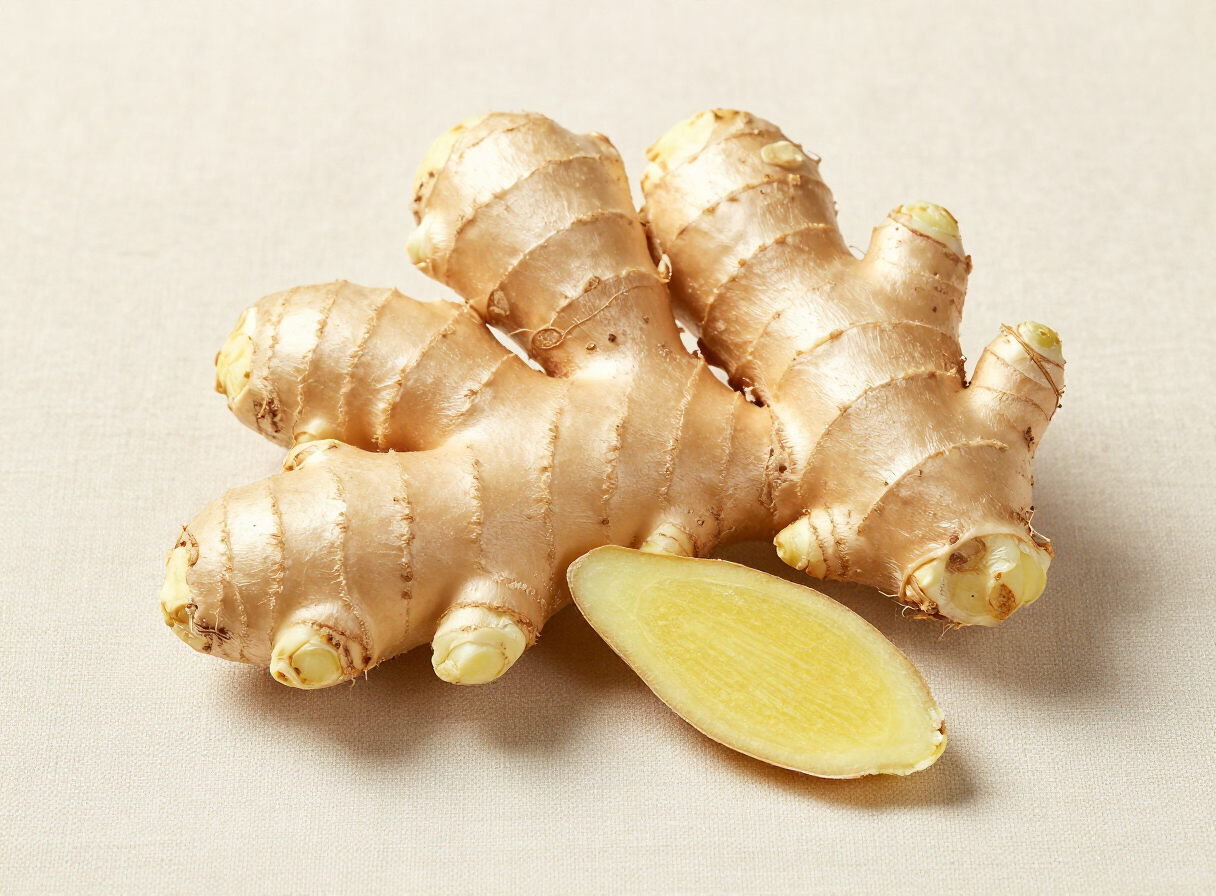
Ginger is the rhizome of Zingiber officinale Roscoe, a Zingiberaceae botanical used widely as a culinary spice and in traditional and contemporary herbal preparations. Human research is substantial but outcome- and preparation-dependent.
Key takeaway
Ginger is not one uniform intervention. Species identity, plant part (rhizome), preparation (fresh, dried, powder, tea, extract, capsule, tablet, essential oil) and whether the product is whole rhizome material or a standardized or specialized extract all matter when interpreting research. Evidence should be discussed separately for pregnancy-related nausea/vomiting, menstrual pain, motion sickness, osteoarthritis/pain and gastrointestinal outcomes rather than collapsed into a general “ginger is effective” statement.
Common uses studied
Culinary spice and food useTraditional herbal usePregnancy-related nausea/vomiting researchMenstrual-pain researchMotion-sickness researchOsteoarthritis and pain researchGastrointestinal-symptom researchCommercial Ginger preparations
Start here
What are you trying to figure out?
Pick the question closest to yours. Each card jumps to the relevant part of this profile or an existing HerbParlor tool — no sponsored rankings, no hidden ordering.
Identity
What is this herb?
Family
Zingiberaceae
Species
Zingiber officinale Roscoe
Common names
GingerGinger rootCommon gingerTrue gingerAdrak
Plant parts used
Rhizome
Geographic context
Kew records Zingiber officinale Roscoe as the accepted species; its rhizome is the principal herbal material. Geographic origin is reported only where supported by the Kew record.
Identification notes
This profile refers to the accepted species Zingiber officinale Roscoe. Ginger root, ginger extract, ginger tea, ginger powder and ginger oil are preparations or forms of the same canonical herb, not separate entities. Ginger essential oil is a distinct preparation and is not interchangeable with oral rhizome products. Other Zingiber species should not be treated as equivalent to Zingiber officinale Roscoe.
Background
Traditional context
Traditions
Asian, Middle Eastern and European culinary and herbal-medicine contexts
Historical uses
Traditional use of Zingiber officinale rhizome preparationsHistorical use related to digestion, nausea and general discomfort
Traditional and culinary use provides historical and cultural context and should not be treated as proof of clinical efficacy. Clinical conclusions should be based on the specific human evidence and preparation studied.
Preparations
Forms & preparations
Forms
Fresh rhizomeDried rhizomeGinger powderTea / infusionCapsuleTabletLiquid extract / tinctureStandardized extractSpecialized preparation (such as steamed extract)Essential oil (distinct preparation)
Preparation methods
Fresh or dried rhizome materialPowdered rhizomeHot-water infusion (tea)Ethanolic or other liquid extractionDry extract preparationStandardized or specialized extraction where explicitly disclosedSteam distillation for essential oil
What changes between forms
- Fresh rhizome, dried rhizome, ginger powder, tea, liquid extract and dry extract are not automatically equivalent preparations.
- A standardized or specialized extract (such as a steamed ginger extract) is a specific preparation and is not interchangeable with ordinary ginger powder, tea or every commercial product.
- Ginger essential oil is a distinct preparation and is not interchangeable with oral rhizome products; oral ingestion of essential oils should not be assumed to be equivalent to rhizome preparations.
- Different ginger preparations may differ in dose, chemical composition, extraction method and clinical evidence.
- Combination formulas should not automatically be treated as evidence for Ginger alone.
Human studies have used different Zingiber officinale preparations, including powders, extracts and specialized preparations such as steamed extracts. Findings from a specific preparation should not automatically be generalized to every Ginger product.
Research
Research Explorer
Each question summarizes what human research has examined, how it was studied, and the main limitations — not a treatment recommendation.
What does human evidence show about Ginger and pregnancy-related nausea/vomiting?
Population
Pregnant individuals studied for nausea- and vomiting-related outcomes in clinical trials, systematic reviews and umbrella reviews of Zingiber officinale preparations.
Intervention
Zingiber officinale rhizome preparations, including powders and extracts where specified.
Comparator
Placebo, no treatment or comparator interventions where used.
Outcomes studied
NauseaVomitingNausea-and-vomiting composite measuresAdverse events
Evidence assessment
There are signals of benefit for pregnancy-related nausea, but the evidence is heterogeneous and the underlying reviews have been judged to be of generally low quality. Nausea and vomiting should be distinguished as outcomes rather than treated as a single measure. Recent umbrella reviews found methodological limitations and heterogeneity that limit confidence. Findings do not establish Ginger as a proven treatment for pregnancy-related nausea or vomiting, and no pregnancy dosage recommendation is provided.
Limitations
- Heterogeneity across included studies and reviews
- Generally low methodological quality of included reviews
- Different preparations, doses, durations and outcome measures
- Findings should not be generalized to every commercial Ginger product
- No pregnancy dosage recommendation is made
What does human evidence show about Ginger and menstrual pain?
Population
Individuals with primary dysmenorrhea studied in clinical trials and a systematic review/meta-analysis of Zingiber officinale preparations.
Intervention
Zingiber officinale rhizome preparations as described in the included studies.
Comparator
Placebo, no treatment or comparator interventions where used.
Outcomes studied
Pain intensityPain reliefAdverse events
Evidence assessment
A 2024 systematic review and meta-analysis reported findings suggestive of reduced menstrual pain. The interpretation is limited by risk-of-bias concerns and an uncertain risk-benefit balance. These findings do not amount to a treatment recommendation and should not be generalized to unrelated pain conditions.
Limitations
- Risk-of-bias concerns in the included studies
- Uncertain risk-benefit balance
- Different preparations, doses and outcome measures
- Not a treatment recommendation
What does human evidence show about motion sickness?
Population
Individuals studied for motion-sickness outcomes in clinical trials of Zingiber officinale preparations.
Intervention
Zingiber officinale rhizome preparations as described in the relevant studies.
Comparator
Placebo or comparator interventions where used.
Outcomes studied
Motion-sickness symptomsNauseaVomiting
Evidence assessment
According to NCCIH, most studies have not shown a benefit of ginger for motion sickness. The evidence does not establish Ginger as an effective motion-sickness treatment.
Limitations
- Most studies have not shown benefit
- Variation in preparations and outcome measures
- Findings should not be generalized to every commercial product
Sources
What does human evidence show about osteoarthritis and pain?
Population
Individuals with osteoarthritis or pain-related conditions studied in clinical research on Zingiber officinale preparations.
Intervention
Oral and, where specified, topical Zingiber officinale preparations.
Comparator
Placebo or comparator interventions where used.
Outcomes studied
PainFunctionStiffnessAdverse events
Evidence assessment
Evidence for osteoarthritis and pain is limited and uncertain, with methodological-quality concerns. Oral and topical ginger evidence should be distinguished. Findings do not establish Ginger as a proven treatment for osteoarthritis or pain.
Limitations
- Limited and uncertain evidence
- Methodological-quality concerns
- Oral and topical preparations should be distinguished
- Findings should not be generalized to every pain condition
Sources
What does human evidence show about gastrointestinal symptoms?
Population
Individuals studied for gastrointestinal-symptom outcomes in clinical research on Zingiber officinale preparations.
Intervention
Zingiber officinale preparations, including a specific steamed ginger extract where studied.
Comparator
Placebo or comparator interventions where used.
Outcomes studied
Gastrointestinal symptomsFunctional dyspepsia measuresAdverse events
Evidence assessment
A 2025 randomized controlled trial examined a specific steamed ginger extract for functional dyspepsia. This is preparation-specific evidence and must not be generalized to ordinary ginger powder, tea or every ginger supplement. Broader gastrointestinal evidence remains limited and preparation-dependent.
Limitations
- Preparation-specific evidence (steamed extract) does not apply to every Ginger product
- Limited and preparation-dependent broader gastrointestinal evidence
- Different preparations and outcome measures
How much do outcomes depend on the preparation studied?
Population
People comparing commercial Ginger products with the preparations studied in human research.
Intervention
Different Zingiber officinale preparations (fresh, dried, powder, tea, extracts, standardized or specialized extracts, essential oil).
Comparator
Not applicable.
Outcomes studied
Preparation identityEvidence interpretability
Evidence assessment
Clinical findings are preparation-dependent. A fresh rhizome, a dried powder, a tea, a standardized extract and a specialized preparation such as a steamed extract may differ in composition and should not be treated as interchangeable interventions. Essential oil is a distinct preparation and is not interchangeable with oral rhizome products.
Limitations
- Commercial labels may omit preparation details
- Studies do not use one uniform Zingiber officinale intervention
- Standardization is not consistently disclosed or comparable
How strong and consistent is the overall human evidence?
Population
Individuals represented across the available Zingiber officinale human clinical literature.
Intervention
Zingiber officinale rhizome preparations studied in human research.
Comparator
Varies by study and review.
Outcomes studied
Pregnancy-related nausea/vomitingMenstrual painMotion sicknessOsteoarthritis/painGastrointestinal symptomsAdverse events
Evidence assessment
The overall human evidence is substantial in volume but inconsistent in quality and outcome. Pregnancy-related nausea shows signals but with heterogeneity and generally low-quality underlying reviews; menstrual-pain evidence is suggestive but risk-of-bias-limited; motion-sickness evidence has not shown benefit in most studies; osteoarthritis/pain evidence is limited and uncertain; and gastrointestinal evidence is preparation-specific. The evidence does not support a universal “ginger is effective” claim across all uses.
Limitations
- Outcome- and preparation-dependent findings
- Heterogeneity and methodological-quality concerns across reviews
- Risk of overinterpreting signals as established efficacy
- Limited ability to infer effects for commercial products
Sources
- Ginger — health information
- Ginger during pregnancy and lactation — evidence scan and umbrella review
- Ginger for pregnancy-related nausea and vomiting — umbrella review of systematic reviews
- Ginger for primary dysmenorrhea — systematic review and meta-analysis
- Steamed ginger extract for functional dyspepsia — randomized controlled trial
Latest evidence
Recently published research
Looking for recent publications…
These publications are automatically discovered from Europe PMC. They have not necessarily been independently reviewed by HerbParlor and are not automatically incorporated into the evidence assessment.
Evidence
Evidence
Human research on Zingiber officinale is substantial but outcome- and preparation-dependent. There are signals of benefit for pregnancy-related nausea and for menstrual pain, but both are limited by heterogeneity, risk-of-bias and methodological-quality concerns; motion-sickness studies have generally not shown benefit; osteoarthritis/pain evidence is limited and uncertain; and gastrointestinal evidence is preparation-specific. Current evidence does not establish Ginger as a proven treatment for pregnancy-related nausea or vomiting, dysmenorrhea, motion sickness, osteoarthritis, functional dyspepsia or any other disease.
Evidence tier
Emerging
Confidence
Overall confidence is emerging rather than established. The main uncertainties concern preparation, dose, duration, study quality, sample size, outcome selection and risk of bias. Evidence from a specific preparation should not automatically be generalized to every Ginger product, and food-level ginger should not be treated as equivalent to concentrated extracts.
Last evidence review
2026-09-20
Where the evidence is strongest
Outcome-specific synthesis that separates pregnancy nausea, menstrual pain, motion sickness, osteoarthritis/pain and gastrointestinal evidencePreparation-aware interpretation distinguishing whole rhizome, powder, extracts and specialized preparations
How to interpret this
Ginger evidence should be interpreted at the level of the identified species, plant part (rhizome), preparation, amount and outcome studied. The current human literature is substantial but heterogeneous and outcome-dependent; it does not justify broad therapeutic claims, dosage recommendations, or automatic equivalence between preparations.
Automatic evidence update
Since the last editorial review
Checking for publications published since the last editorial evidence review…
This automatic update detects newly published literature; it does not replace HerbParlor's editorial evidence assessment. Review status is an automatic triage signal. Curated HerbParlor evidence is unchanged until editorial review.
Boundaries
What the evidence does NOT establish
Areas with limited evidence
- A universal “ginger is effective” claim across all uses
- Generalization across powders, teas, extracts and essential oils
- Pregnancy dosage recommendations
- Translation of laboratory or mechanistic findings to patient-important outcomes
Evidence gaps
- Larger, longer and well-described randomized trials with low risk of bias
- Direct comparisons of fresh, dried, powder, extract and specialized preparations
- Consistent reporting of preparation, amount and extract characteristics
- Independent confirmation of clinically meaningful outcomes across conditions
Common misconceptions
- Ginger powder is not automatically equivalent to a standardized extract.
- A study of one ginger extract does not validate every ginger supplement.
- Culinary ginger and concentrated supplements are not automatically interchangeable.
- Traditional use is not clinical proof.
- More ginger does not automatically mean better evidence.
- Evidence for pregnancy nausea should not be generalized to every nausea condition.
- Evidence for menstrual pain does not establish effectiveness for unrelated pain conditions.
- A ginger-containing combination product does not provide the same evidence as Ginger alone.
Safety
Safety & interactions
General considerations
- Oral ginger can cause abdominal discomfort, heartburn, diarrhea, and mouth or throat irritation.
- Safety should be interpreted according to the specific preparation, amount and duration studied. Culinary use and concentrated supplements or extracts should be distinguished; food-level ginger should not be assumed to be equivalent to concentrated extracts.
- Pregnancy evidence is outcome- and preparation-specific; avoid blanket safety claims for pregnancy, and do not provide a pregnancy dosage recommendation.
- Oral rhizome preparations should be distinguished from essential oils and topical products; essential oils are not interchangeable with oral rhizome products.
- Medication and herb interaction uncertainty should be acknowledged; the available sources do not establish an exhaustive interaction list.
Pregnancy & nursing
- Pregnancy and breastfeeding safety is outcome- and preparation-specific and should not be assumed for every Ginger preparation, particularly concentrated extracts.
- People who are pregnant or breastfeeding should discuss a specific product with a qualified healthcare professional.
Medication interactions to be aware of
The available sources do not establish a complete interaction profile for every Zingiber officinale preparation. People taking medicines should discuss a specific product with a qualified healthcare professional rather than infer safety from culinary or traditional use.
Condition considerations
- People with gastrointestinal, bleeding or other medical conditions should not use this profile as a substitute for clinical care.
- Uncertainty is greater when a product does not identify its plant part, preparation or amount.
Reported adverse effects
- Abdominal discomfort
- Heartburn
- Diarrhea
- Mouth or throat irritation
Duration
- Long-term safety of concentrated Zingiber officinale extracts is not equally established for every commercial product.
Talk to a healthcare professional if any apply
- Pregnancy or breastfeeding
- Use of prescription medicines
- Gastrointestinal, bleeding or other relevant medical conditions
- Use of a concentrated or specialized extract with unclear composition
- Use of essential oil or topical products
- Significant or unexpected adverse effects
Products
What changes between products?
Form differences
- Fresh rhizome, dried rhizome, ginger powder, tea, liquid extract and dry extract are not automatically equivalent preparations.
- A standardized or specialized extract (such as a steamed ginger extract) is a specific preparation and is not interchangeable with ordinary ginger powder, tea or every commercial product.
- Ginger essential oil is a distinct preparation and is not interchangeable with oral rhizome products; oral ingestion of essential oils should not be assumed to be equivalent to rhizome preparations.
- Different ginger preparations may differ in dose, chemical composition, extraction method and clinical evidence.
- Combination formulas should not automatically be treated as evidence for Ginger alone.
Form considerations
- Fresh rhizome, dried rhizome, powder, tea, liquid extract and dry extract can represent different amounts and preparations.
- Essential oil is a distinct preparation and is not interchangeable with oral rhizome products.
- Do not compare products solely by package size or headline ginger weight.
Plant part considerations
- Confirm that the product uses identified Zingiber officinale rhizome material when that is the intended preparation.
- Do not treat other plant parts or other Zingiber species as automatically equivalent.
Extract considerations
- Record extract characteristics only when the product source explicitly provides them.
- Do not infer an extraction ratio, concentration or clinical equivalence from a label that does not provide it.
Standardization considerations
- Record declared standardization only when genuinely disclosed.
- Do not invent gingerol percentages, extract ratios or a preferred marker threshold.
- Do not imply that a standardized product is automatically more effective.
Evaluation
How to evaluate a supplement
What to check
- Zingiber officinale species identity
- Plant part, especially rhizome versus other material
- Fresh versus dried material where disclosed
- Whole material versus extract
- Powder, tea, extract, capsule, tablet or other preparation
- Amount per serving and serving information
- Extract characteristics where explicitly disclosed
- Standardization where explicitly disclosed
- Marker compounds only where genuinely specified
- Whether the product is Ginger alone or a combination formula
- Other ingredients and label transparency
- Identity, contaminant and batch testing where disclosed
Serving considerations
- Compare the labelled amount and preparation with the intervention used in the relevant research without inventing a dosage recommendation.
- A larger declared amount does not automatically mean a stronger or better-supported product.
Testing considerations
- Look for species and plant-part identity testing where disclosed.
- Look for contaminant testing and batch or lot traceability where disclosed.
- Treat testing information as a product-quality disclosure, not as proof of clinical efficacy.
Label transparency
- The species and plant part should be clear where possible.
- Fresh, dried, powder, extract and other preparation details should be explicit.
- The amount per serving should be explicit.
- Combination ingredients should be listed.
- Extract or standardization claims should be specific and sourceable.
- Marketing language should not be treated as human clinical evidence.
Supplements
Related supplements
- Nani Ingefær (90 kapsler)NaniView product
- Natur Drogeriet Ingefær Ø (150 kap)Natur DrogerietView product
- Lekaform Ingefær 300 mg (300 tabletter)LekaformView product
- Biogan Ingefærpulver Ø (100 g)BioganView product
- Eclectic Herb, Ginger, 395 Mg, 90 Veg CapsEclectic HerbView product
- Solaray, True Herbs Ginger Root, 550 Mg, 100 Veg CapsSolarayView product
- Solaray, Fermented Ginger, 400 Mg, 100 Veg CapsSolarayView product
- Nature's Answer, Ginger Root Fluid Extract Alcohol-Free, 1000 Mg, 1 OzNature's AnswerView product
- Nature's Way, Ginger Root, 100 CapsNature's WayView product
- Celebration Herbals, Organic Ginger Root Tea, 24 BagsCelebration HerbalsView product
Sources
Authoritative sources referenced
- Zingiber officinale Roscoe — Plants of the World Online
Royal Botanic Gardens, Kew · accessed 2026-09-20
- Zingiberis rhizoma — European Medicines Agency herbal monograph
European Medicines Agency · accessed 2026-09-20
- Ginger — health information
National Center for Complementary and Integrative Health · accessed 2026-09-20
- Ginger during pregnancy and lactation — evidence scan and umbrella review
Advances in Nutrition / PubMed · 2024-10-01 · accessed 2026-09-20
- Ginger for pregnancy-related nausea and vomiting — umbrella review of systematic reviews
Phytotherapy Research / PubMed · 2026-05-01 · accessed 2026-09-20
- Ginger for primary dysmenorrhea — systematic review and meta-analysis
Journal of Integrative and Complementary Medicine / PubMed · 2024-05-01 · accessed 2026-09-20
- Steamed ginger extract for functional dyspepsia — randomized controlled trial
Food & Function / PubMed · 2025-09-01 · accessed 2026-09-20
Sections reviewed
overviewbotanicaltraditionalContextpreparationsresearchevidencesafetyproductEvaluationrelationshipssources
Created the Ginger Herb Profile v1 with canonical Zingiber officinale Roscoe identity, rhizome as canonical herbal material, preparation-aware human evidence across pregnancy nausea/vomiting, menstrual pain, motion sickness, osteoarthritis/pain and gastrointestinal outcomes, cautious safety framing, product-evaluation criteria and auditable review metadata.
This profile is provided for educational purposes only and is not medical advice. Traditional context and research summaries are distinguished from claims, and nothing here is a treatment recommendation. Always consult a qualified healthcare professional before using any herb, especially if you are pregnant, nursing, take medication, or have a medical condition.